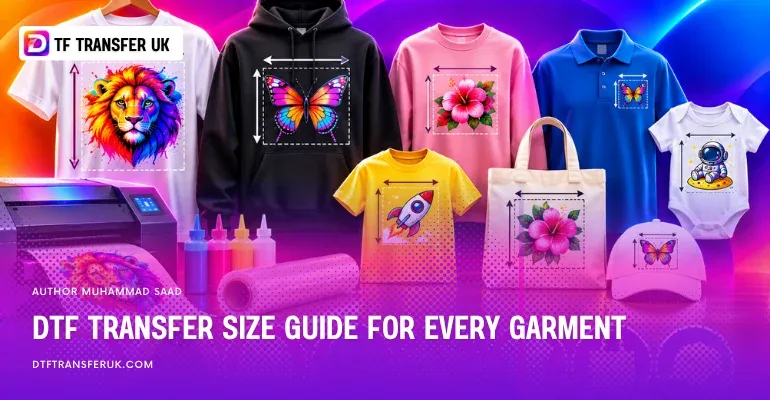
A DTF transfer size guide provides recommended print dimensions for different garment sizes, age groups, and design placements. Standard adult T shirt transfers are usually 25 to 30 cm wide, while youth designs range from 20 to 25 cm and toddler prints from 14 to 18 cm.
Smaller designs are suitable for chest logos, sleeves, hats, and trouser legs. The correct transfer size depends on the garment's printable area, design proportions, and placement. Accurate sizing prevents oversized prints, poor alignment, and loss of artwork detail.
At DTF Transfer UK, our gang sheets measure 56 × 100 cm, allowing multiple designs to be arranged according to their required dimensions.
The following DTF transfer size chart provides practical starting measurements for common garments.
Garment or Placement | Recommended Print Width |
|---|---|
Baby clothing | 10 to 13 cm |
Toddler T shirts | 14 to 18 cm |
Youth T shirts | 20 to 25 cm |
Adult T shirts (S to M) | 25 to 28 cm |
Adult T shirts (L to XL) | 28 to 30 cm |
Adult T shirts (2XL and above) | 30 to 33 cm |
Adult full back | 28 to 35 cm |
Left chest logo | 7.5 to 10 cm |
Hoodie front | 25 to 28 cm |
Sleeve logo | 5 to 8 cm |
Hat front | 9 to 11 cm |
What Are the DTF Transfer Sizes for Different Ages?
DTF transfer sizes for different ages generally range from 10 to 13 cm wide for babies, 14 to 18 cm for toddlers, 20 to 25 cm for children, and 25 to 33 cm for adults. These measurements refer to typical full front designs and should be adjusted according to garment dimensions.
Children's clothing requires smaller prints because the chest area is narrower and shorter. An adult sized design placed on a toddler's T shirt may extend into the sleeves, side seams, or lower hem.
Age Group | Recommended Full Front Width | Typical Placement |
|---|---|---|
Babies (0 to 2 years) | 10 to 13 cm | Centre front |
Toddlers (2 to 4 years) | 14 to 18 cm | Centre chest |
Young children (5 to 8 years) | 16 to 20 cm | Centre front |
Older children (9 to 12 years) | 20 to 23 cm | Centre front |
Teenagers (13 to 17 years) | 23 to 28 cm | Centre front |
Adults (S to M) | 25 to 28 cm | Centre front |
Adults (L to XL) | 28 to 30 cm | Centre front |
Adults (2XL and above) | 30 to 33 cm | Centre front |
Age alone does not determine the correct transfer size. A 12 year old wearing an adult small T shirt may need a larger print than another child of the same age wearing a youth medium.
For example, a 28 cm wide design may look balanced on an adult medium shirt but occupy too much space on a youth small.
What Are the DTF Transfer Sizes for Different Garment Types?
DTF transfer sizes for different garments depend on their shape, fabric construction, and available printing surface.
T shirts commonly support full front and back graphics, while polo shirts, tank tops, hoodies, sweatpants, and hats often require smaller or specially positioned designs.
Garment Type | Recommended Transfer Size | Suitable Print Area |
|---|---|---|
Adult T shirt front | 25 to 30 cm wide | Centre front |
Adult T shirt back | 28 to 35 cm wide | Upper or full back |
Polo shirt | 7.5 to 10 cm wide | Left or right chest |
Tank top or vest | 18 to 25 cm wide | Centre front |
Hoodie front | 25 to 28 cm wide | Above pouch pocket |
Hoodie back | 28 to 33 cm wide | Upper or full back |
Sweatshirt | 25 to 30 cm wide | Front or back |
Zip hoodie | 7.5 to 10 cm wide | Chest panel |
Sweatpants or joggers | 6 to 10 cm wide | Upper thigh or vertical leg |
Shorts | 6 to 10 cm wide | Thigh area |
T shirt short sleeve | 5 to 8 cm wide | Outer sleeve |
Long sleeve | 5 to 7 cm wide | Vertical sleeve design |
Hat or cap | 9 to 11 cm wide | Front panel |
Beanie | 5 to 8 cm wide | Front cuff |
Jacket or workwear | 8 to 10 cm chest logo | Chest or back panel |
Tote bag | 20 to 25 cm wide | Flat front panel |
Apron | 18 to 23 cm wide | Upper front panel |
T Shirts: A full front transfer typically measures 25 to 30 cm wide, while a full back design can reach 28 to 35 cm, depending on the garment. Smaller chest logos work well for company branding, uniforms, and minimalist designs.
Polo Shirts and Tank Tops: Polo shirts commonly feature 7.5 to 10 cm chest logos positioned beside the button placket. Tank tops have narrower shoulder and chest sections, so print width should be adjusted to the available fabric panel.
Hoodies and Sweatshirts: Hoodie graphics must account for pouch pockets, drawstrings, zips, and the hood itself. A full front design should remain above the pocket seam. Sweatshirts without front pockets generally provide more uninterrupted printing space.
Sweatpants and Shorts: Joggers frequently use small thigh logos or narrow vertical prints along the leg. The design should remain clear of pockets, side seams, and highly stretched areas.
Hats and Beanies: Cap designs are typically around 9 to 11 cm wide and 5 to 6 cm high. Structured caps require equipment capable of applying even pressure to their curved front panels. Beanie designs are usually smaller to fit the folded cuff.
Jackets, Bags, and Workwear: These items require measurements based on their flat printable panels. Check seams, linings, waterproof coatings, reflective tape, and material heat resistance before applying DTF transfers.
What Are the DTF Transfer Sizes for Different Placement Types?
DTF transfer sizes for different placements range from approximately 5 cm for small neck or sleeve logos to 35 cm for large adult back graphics. Placement determines both the design dimensions and its position relative to the collar, shoulder seams, pockets, and garment centreline.
Placement Type | Recommended Print Size | Placement Guide |
|---|---|---|
Full front | 25 to 30 cm wide | Around 5 to 9 cm below front collar |
Full back | 28 to 35 cm wide | Around 7 to 10 cm below back collar |
Centre chest | 18 to 25 cm wide | Upper chest, centred |
Left chest | 7.5 to 10 cm wide | Upper left chest |
Right chest | 7.5 to 10 cm wide | Upper right chest |
Back neck | 5 to 8 cm wide | Around 2 to 4 cm below collar |
Short sleeve | 5 to 8 cm wide | Flat outer sleeve panel |
Long sleeve | 5 to 7 cm wide | Vertical design along sleeve |
Upper thigh | 6 to 10 cm wide | Front or outer thigh |
Vertical trouser leg | 6 to 10 cm wide | Along the leg panel |
Cap front | 9 to 11 cm wide | Centre of front crown |
Why Does DTF Transfer Sizing Matter?
DTF transfer sizing matters because the dimensions and placement of a design affect its appearance, readability, garment comfort, and application quality. Correct sizing keeps the print proportional to the garment while allowing important artwork details to remain visible.
What Are the Common DTF Transfer Sizing Mistakes?
Common DTF transfer sizing mistakes include selecting artwork that is too large or small, ignoring garment measurements, distorting the design's proportions, and placing transfers too close to seams or pockets.
Using One Transfer Size for Every Garment
A 30 cm design may suit an adult large T shirt but appear oversized on a youth garment. Prepare suitable size variations when decorating different age groups or garment cuts.
Ignoring the Actual Printable Area
Garment labels do not provide exact printing dimensions. Two medium shirts from different manufacturers may have different chest widths, armhole positions, and overall lengths.
Measure the available area instead of relying entirely on the clothing size label.
Stretching Artwork to Fit a Different Shape
Changing width and height independently can distort logos, lettering, and illustrations. Resize designs proportionally so the original aspect ratio remains unchanged.
Using Low Resolution Artwork
Enlarging small raster images can produce pixelated edges and unclear details. Prepare artwork at a minimum of 300 DPI at the final intended print dimensions, as recommended by DTF Transfer UK's artwork guidelines.
Placing Designs Over Seams or Pockets
Raised seams, zips, pocket edges, and thick fabric sections can prevent even heat press pressure. Keep transfers within smooth fabric areas or use suitable heat press accessories.
Ignoring the Design's Height
Width alone does not determine whether a graphic fits. A narrow vertical design may still extend too close to the garment hem, collar, or pouch pocket.