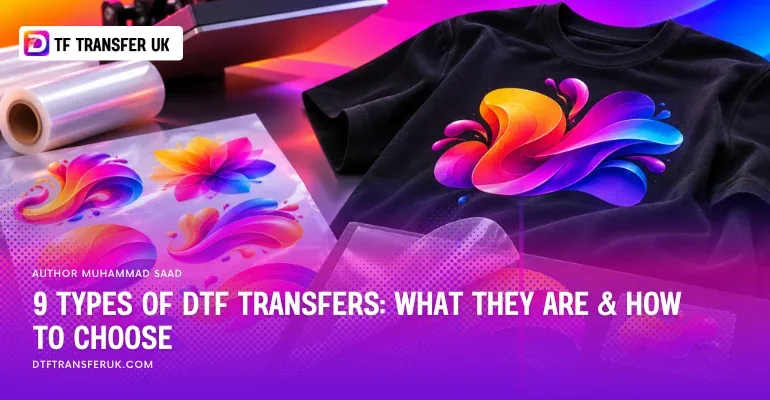
DTF transfers are available in different types, including standard, glitter, metallic, reflective, glow-in-the-dark, neon, holographic, puff and UV DTF transfers.
Each type serves a different purpose, from printing everyday full-colour logos on clothing to creating sparkling, raised or light-reactive designs.
Standard DTF transfers are commonly used for T-shirts, hoodies and workwear, while speciality transfers provide decorative finishes for fashion, promotional merchandise and event clothing.
UV DTF transfers use a different printing process and are designed primarily for hard surfaces such as glass, metal and plastic.
Choosing the right type depends on the material you want to decorate, the appearance of your design, how the finished product will be used and the application equipment available.
1. Standard DTF Transfers
Standard DTF transfers are full-colour printed designs applied to fabric using heat and pressure. They are produced by printing specialised inks onto PET film, adding adhesive powder and curing the adhesive before transferring the design to a garment.
This type reproduces photographs, logos, illustrations, gradients and multicolour artwork without requiring separate vinyl layers for each colour. For example, a clothing business can use standard DTF transfers to print a detailed company logo on cotton T-shirts or a large graphic on the back of a hoodie.
Standard DTF transfers are commonly used for everyday clothing, branded workwear, uniforms, tote bags and promotional merchandise. Choose standard DTF transfers when you need detailed, full-colour fabric printing without an additional decorative effect. They are also practical for wholesale orders containing repeated designs or multiple logos arranged on gang sheets.
2. Glitter DTF Transfers
Glitter DTF transfers are speciality fabric transfers that add a sparkling finish to printed artwork. They use glitter-effect materials or coatings within the transfer system to create a shimmering appearance when light reaches the design.
This type combines printed artwork with a decorative sparkle, making the finished design more noticeable than an ordinary flat print. For example, a dance school can use glitter DTF transfers for its logo on performance T-shirts, while a clothing brand can use them for sparkling lettering on hoodies.
Glitter DTF transfers are suitable for dancewear, party clothing, children's fashion, festive merchandise and statement graphics. Choose glitter DTF transfers when the design needs a visible sparkling effect, particularly for bold lettering, shapes and decorative artwork. The exact texture and appearance depend on the glitter film or transfer product used.
3. Metallic or Foil DTF Transfers
Metallic DTF transfers are speciality heat transfers that produce a metal-like finish, commonly in gold, silver or other metallic shades. Depending on the product, the effect can be created using specialised metallic transfer materials or a foil bonding process.
These transfers give printed artwork a shiny metallic appearance that standard CMYK DTF inks cannot reproduce on their own. For example, a fashion brand can apply a gold metallic logo to a black sweatshirt, or a business can use silver lettering on premium promotional clothing.
Metallic DTF transfers are used for luxury-style branding, fashion collections, special-event garments and decorative logos. Choose metallic DTF transfers when you want a gold, silver or similar metallic finish rather than an ordinary printed colour. Bold lettering and solid shapes are often more suitable than very fine artwork, and some metallic systems accept only single-colour designs.
4. Reflective DTF Transfers
Reflective DTF transfers are specialised garment transfers designed to reflect incoming light towards its source. They use reflective materials that make the design appear brighter when illuminated from a suitable angle, particularly by headlights or a camera flash.
For example, a running club can use reflective lettering on training tops, while a delivery business can add reflective branding to compatible work jackets. The reflective effect depends on the material, lighting direction and viewing angle rather than making the entire garment continuously bright.
Reflective DTF transfers are used for sportswear, running clothing, cycling apparel, workwear and visibility-focused fashion designs. Choose reflective DTF transfers when you want a printed design to react strongly to direct light. However, decorative reflective transfers should not be treated as certified high-visibility safety equipment unless the finished garment meets the relevant safety requirements.
5. Glow-in-the-Dark DTF Transfers
Glow-in-the-dark DTF transfers are fabric transfers made with phosphorescent materials that absorb light and release a visible glow in darkness. The design must first be exposed to daylight or another suitable light source before its glow becomes visible.
Unlike ordinary printed graphics, this type produces a temporary light-emitting effect after the surrounding lights are switched off. For example, an event organiser can use glow-in-the-dark lettering on concert T-shirts, while a clothing brand can create Halloween designs that become visible in a dark room.
Glow-in-the-dark DTF transfers are used for novelty clothing, children's garments, costumes, parties and entertainment merchandise. Choose glow-in-the-dark DTF transfers when the design needs to remain visibly decorative after the lights go out. The glow gradually fades and must be recharged by light, so it should not be confused with a permanent light source or certified safety marking.
6. Neon or Fluorescent DTF Transfers
Neon DTF transfers are speciality printed transfers that use fluorescent inks or compatible materials to create unusually bright colours. These colours are intended to appear more intense than those produced by conventional CMYK printing, particularly under suitable lighting.
For example, a fitness brand can use fluorescent orange lettering on sportswear, while an event company can print bright green or pink artwork on promotional T-shirts. Some fluorescent formulations also react strongly under ultraviolet lighting, although this depends on the particular ink.
Neon DTF transfers are used for sportswear, event merchandise, fashion collections, promotional campaigns and attention-grabbing branding. Choose neon DTF transfers when you need bold fluorescent colours that stand out in normal lighting. Unlike glow-in-the-dark transfers, fluorescent transfers do not continue glowing in complete darkness after the light source is removed.
7. Holographic DTF Transfers
Holographic DTF transfers are speciality transfers that produce a shifting, multicoloured visual effect as the viewing angle or lighting changes. The appearance comes from a holographic-effect layer or film rather than ordinary printed colour alone.
This type creates an iridescent finish that can show different colours as the garment moves. For example, a streetwear brand can use holographic lettering on a sweatshirt, while an entertainment business can decorate merchandise with colour-shifting logos.
Holographic DTF transfers are suitable for fashion clothing, festival merchandise, statement graphics and creative branding. Choose holographic DTF transfers when you want a design that changes appearance with movement and light. The effect is particularly noticeable in larger graphic areas, although its exact appearance depends on the transfer material.
8. Puff DTF Transfers
Puff DTF transfers are speciality garment transfers designed to create a raised, three-dimensional printed effect. They use an expanding or dimensional transfer system that develops additional height when activated by heat.
Puff transfers are used for streetwear, fashion branding, varsity-style lettering and decorative clothing designs. Choose puff DTF transfers when you want the artwork to have noticeable height and texture instead of a flat printed finish.
They generally suit bold letters and simple shapes better than extremely fine details. Because suppliers use different dimensional printing technologies, confirm that the product is genuinely a compatible puff DTF transfer and follow its specific pressing instructions.
9. UV DTF Transfers
UV DTF transfers are designs printed using ultraviolet-curable inks and transferred onto compatible hard surfaces using adhesive and pressure. Unlike standard textile DTF transfers, UV DTF does not require hot-melt adhesive powder or a heat press during application.
The printed design is carried on a specialised film system, positioned on a clean surface and pressed into place. The carrier is then removed, leaving the artwork attached to the object. For example, a promotional products business can use UV DTF transfers to decorate stainless steel tumblers, glass jars, acrylic keyrings or smooth plastic phone cases.
UV DTF transfers are used for personalised gifts, drinkware, product packaging, accessories and promotional products. Choose UV DTF transfers when you need to decorate a suitable smooth, rigid surface rather than fabric. Textured, flexible or porous surfaces may not provide reliable adhesion, and decorated drinkware should only be considered dishwasher-safe when the supplier specifically confirms it.
How to Choose the Right DTF Transfer Type for Your Project?
To choose the right DTF transfer type for your project, start by identifying the material you want to decorate, the appearance you want to achieve and how the finished product will be used.
Standard DTF transfers are suitable for most everyday full-colour garment designs, while speciality transfers are useful when you need sparkle, metallic shine, reflection, fluorescence, glow or raised texture.
UV DTF is a separate option for compatible hard surfaces. Before ordering, consider the garment's fabric, the design's level of detail, the supplier's application requirements and the quantity you need, particularly when purchasing wholesale DTF transfers.
Check the material you want to decorate. Choose standard or compatible speciality textile DTF transfers for T-shirts, hoodies, tote bags and other suitable fabrics. For smooth glass, metal, acrylic or rigid plastic products, consider UV DTF transfers instead.
Decide what appearance your design needs. Choose standard DTF for ordinary full-colour artwork, glitter for sparkle, metallic for a foil-like finish, holographic for colour-changing effects or puff for raised lettering. If you need bright colours, consider neon DTF, while reflective and glow-in-the-dark transfers serve different light-reactive purposes.
Consider how the product will be used. Everyday uniforms and promotional T-shirts may only need standard DTF transfers, while event clothing and fashion merchandise may benefit from speciality finishes. For heavily stretched garments or frequently washed workwear, confirm that the transfer is compatible with the intended use and fabric.
Match the transfer to your artwork. Standard DTF transfers are usually suitable for photographs, gradients and detailed multicolour logos. Metallic, puff and some reflective transfers may work better with bold shapes, thicker lettering or simplified artwork. Check the supplier's design restrictions before submitting files.
Check the application requirements. Confirm the recommended heat-press temperature, time, pressure and film-peeling method. Speciality DTF transfers may require different conditions from standard transfers, while UV DTF transfers are applied using pressure without a heat press.
Compare prices and order quantities. Standard DTF transfers are a practical starting point for bulk garment printing, especially when multiple designs can be arranged on a gang sheet. Speciality finishes may cost more because of their materials or production requirements. Compare wholesale pricing, available sheet sizes and minimum order quantities before placing a large order.
Test the transfer before bulk production. Order a sample and check the printed appearance, adhesion, fabric compatibility and wash performance. This is especially important for stretch garments, coated fabrics, speciality finishes and any transfer being used on an unfamiliar material.